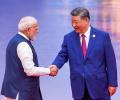
India and China held diplomatic talks to review the situation along the Line of Actual Control (LAC), discussing boundary delimitation, border management, and trans-border cooperation. Both nations stressed the importance of maintaining peace and tranquillity for bilateral relations and agreed to continue using existing channels to resolve outstanding issues.

India and China have agreed to advance discussions on an "Early and Substantial Harvest" of boundary delimitation and border management during the 25th round of Special Representatives talks between National Security Advisor Ajit Doval and Chinese Foreign Minister Wang Yi in Beijing. Both sides reached an eight-point consensus, committing to the 2005 Agreement on Political Parameters and Guiding Principles for Settlement. Key outcomes include enhancing border management, improving understanding of the Line of Actual Control, establishing new meeting points and hotlines, and continuing cooperation on trans-border rivers and pilgrimage.

Former CDS Anil Chauhan stated that China poses a long-term and comprehensive challenge to India, with the boundary issue remaining unresolved due to differing perceptions of the Line of Actual Control. However, he emphasised that India's ties with Beijing cannot be solely defined by border disputes, advocating for engagement through platforms like SCO and BRICS. He also highlighted the broader global geopolitical flux and instability in India's neighbourhood as significant security concerns, stressing the need for self-reliance.
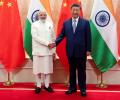
India has asserted that the state of its border with China directly impacts the broader bilateral relationship, emphasising the critical importance of maintaining peace and tranquillity along the Line of Actual Control (LAC). The Ministry of External Affairs also firmly rejected China's claims over Arunachal Pradesh, reiterating its status as an integral part of India. This stance was reiterated during a recent Working Mechanism for Consultation and Coordination meeting, where both sides agreed to continue using diplomatic and military channels to resolve outstanding issues.

India on Tuesday conveyed to China the importance of maintaining peace and tranquility along the Line of Actual Control (LAC) for overall bilateral ties as national security advisor Ajit Doval held talks with Chinese Foreign Minister Wang Yi focusing on delimitation of the frontier and sustaining work on trans-boundary cooperation.
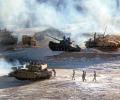
While tensions have eased at several friction points and mechanisms for managing the boundary have been reactivated, underlying differences persist. Disputes over naming practices in Arunachal Pradesh, continued infrastructure development on both sides, and unresolved questions regarding patrolling rights indicate that the structural gap remains, notes Dr Kumar.

India and China held constructive talks on the situation along the Line of Actual Control (LAC) in eastern Ladakh, emphasising that maintaining border peace and tranquillity enabled progress in normalising overall relations.

National Security Adviser Ajit Doval held "constructive" talks with Chinese Foreign Minister Wang Yi in New Delhi, focusing on the normalisation of bilateral ties. The discussions reviewed recent developments and progress towards rebuilding trust after the eastern Ladakh border standoff. Both sides have implemented measures, including disengagement pacts and high-level meetings, to improve relations.

National Security Advisor Ajit Doval is in Beijing for the 25th round of Special Representatives talks on the India-China boundary issue with his Chinese counterpart Wang Yi. These crucial discussions precede Chinese President Xi Jinping's anticipated visit to India for the BRICS summit, offering a potential opportunity for a meeting with Prime Minister Narendra Modi. The talks aim to address the long-standing border dispute and recurring tensions, with both sides emphasising the importance of peace and tranquillity for bilateral relations amidst recent reports of aggressive Chinese posturing in Arunachal Pradesh.
National security advisor Ajit Doval arrived in Beijing on Monday for a two-day visit to take part in the Special Representatives talks on the India-China boundary question with his Chinese counterpart and Foreign Minister Wang Yi.

External Affairs Minister S Jaishankar met his Chinese counterpart Wang Yi in Manila, reiterating that peace and tranquillity in border areas are prerequisites for normal India-China relations. He stressed the importance of mutual respect, interest, and sensitivity, while also raising concerns about market access, trade imbalance, and supply chain uncertainties.

Arunachal Pradesh Chief Minister Pema Khandu has stated his government will verify reports of alleged Chinese incursions in the Taksing sector of Upper Subansiri district. The claims, made by the Nah Welfare Society, suggest Chinese PLA personnel entered areas near villages close to the Line of Actual Control. Khandu plans to consult with the Indian Army and local bodies before drawing conclusions, while the Army previously rejected similar allegations from the NWS.

Defence Minister Rajnath Singh met his Chinese counterpart Admiral Dong Jun in Bishkek to discuss maintaining peace and tranquility along the Line of Actual Control (LAC) and broader regional security concerns.

India has strongly criticised China's practice of assigning 'fictitious names' to areas within Indian territory, stating that such actions are futile attempts to alter reality and negatively impact efforts to normalise bilateral relations.

The Indian and Chinese militaries held a fresh round of high-level military talks focusing on maintaining peace and security along the Line of Actual Control (LAC) in eastern Ladakh.

Phunchuk Stobdan's forte was candour and strong views on India's defence. Naturally, India's adversaries were in awe of him, fearing his views and unyielding stand on boundary issues, remembers Tarun Vijay.

India and China will resume direct flight services by the end of this month after a five-year gap, signaling an effort to rebuild ties strained by the border standoff in eastern Ladakh.
Chinese President Xi Jinping described India and China as "good neighbours, friends and partners", saying that achieving "dragon and elephant dancing together" is the right choice for both countries.

India and China held diplomatic talks in Beijing, focusing on effective border management and the resumption of cross-border cooperation and exchanges, including on trans-border rivers and the Kailash-Mansarovar Yatra. The meeting explored measures and proposals to implement decisions made during the Special Representatives (SR) dialogue in December. Both sides agreed to work together for the next SR meeting in India later this year.

'After the Galwan clash, the rules of engagement changed with the army commanders allowed to use any means at their disposal as they deem fit for tactical operations.'

India and China reviewed the situation along the Line of Actual Control (LAC) in eastern Ladakh and prepared for the next Special Representatives' dialogue on the boundary question.

General Manoj Mukund Naravane's memoir has triggered a controversy by revealing behind-the-scenes decision-making during the 2020 India-China standoff in Ladakh. Its candid account of military and political responses at a critical moment has reignited debate over civil-military relations, accountability, and the limits of disclosure in matters of national security.

Chinese airline China Eastern is set to begin its Delhi-Shanghai flight from Sunday, days after IndiGo's flight to Guangzhou from Kolkata, marking the resumption of the flight services between the two countries after a gap of five years.
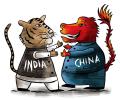
India and China have announced a series of measures aimed at improving their relationship, including maintaining peace along the border, reopening border trade, and resuming direct flights.

The key meeting was held in Beijing on March 27, the MEA said in a statement.
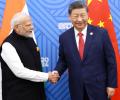
Chinese President Xi Jinping on Wednesday pledged to strengthen the strategic relationships with neighbouring countries by 'appropriately' managing differences and enhancing supply chain ties as China's tariff war with the United States escalated.

During the meeting, it was reiterated that "restoration of peace and tranquillity, and respect for the LAC are the essential basis for restoration of normalcy in bilateral relations", it said.
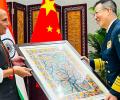
Defence Minister Rajnath Singh, in his meeting with Chinese counterpart Dong Jun in Qingdao on June 26, proposed that India and China should solve the "complex issues" under a structured roadmap comprising steps to de-escalate tensions along the frontiers and rejuvenate the existing mechanism to demarcate the borders.

India and China on Wednesday held 'constructive' and 'forward-looking' diplomatic talks to resolve the over four-year border standoff along the Line of Actual Control (LAC) in eastern Ladakh but there was clear no indication of any breakthrough.

India and China have held their first diplomatic talks since withdrawing troops from two face-off points in eastern Ladakh, reflecting on the lessons learned from the border row to prevent future incidents. The two sides agreed to maintain peace and tranquillity in border areas, prepare for the next meeting of Special Representatives on the boundary question, and highlighted the importance of regular exchanges and contacts at diplomatic and military levels. The talks come after the completion of the disengagement process from the last two friction points, following an agreement finalized in October 2022.
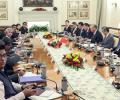
Chinese Foreign Minister Wang Yi's visit to India focuses on border talks with NSA Ajit Doval, amidst efforts to rebuild relations after the Galwan Valley clashes and rising India-US tensions.

India is preparing to resume the Kailash Mansarovar Yatra, a pilgrimage to Mount Kailash in Tibet, after a three-year hiatus. The decision comes as part of efforts to improve relations between India and China, which have been strained since a military standoff in 2020. The two countries have also agreed in principle to resume flight services between them.
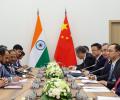
According to informed sources, Doval will arrive in Beijing on Tuesday to attend the crucial talks, which were expected to provide a way forward for the two countries to normalise the relations.
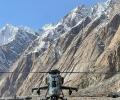
Defence sources stated that the disengagement involves removing infrastructure and withdrawing troops from both sides. The process is expected to be completed by Tuesday.

The two sides had started coordinated patrols in the first week of the month after completing disengagement in both Demchok and Depsang in the last week of October.
He said that the two nations will have issues in the foreseeable future. However, there are ways of addressing those issues and what happened in 2020 was not the way to address those issues.
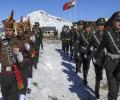
India on Monday announced it has reached an agreement with China on patrolling along the Line of Actual Control (LAC) in eastern Ladakh, in a major breakthrough in ending the over four-year-long military standoff ahead of a likely meeting between Prime Minister Narendra Modi and Chinese President Xi Jinping in Russia this week.

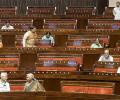
India's External Affairs Minister S Jaishankar has stated that peace and tranquility in border areas are essential for the development of bilateral ties with China. He said India will be discussing de-escalation and effective management of activities in border areas with China in the coming days, following the completion of troop disengagement in eastern Ladakh. Jaishankar emphasized the importance of respecting the Line of Actual Control (LAC), maintaining the status quo, and adhering to past agreements. The disengagement phase allows for discussions on other aspects of bilateral engagement, with national security interests prioritized. However, the statement sparked an uproar in the Rajya Sabha, with Opposition MPs demanding clarifications that were disallowed by the Chair, leading to a walkout.
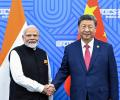
Prime Minister Narendra Modi has emphasized dialogue over discord in India's relationship with China, acknowledging natural differences between the two countries but stressing that stronger cooperation is essential for their mutual interests and global stability. In a podcast with Lex Fridman, Modi highlighted the ongoing efforts to restore normalcy along the border following the 2020 clashes, emphasizing the importance of a stable and cooperative relationship.
The actions on the ground would be confirmed and are expected to be followed up soon.
